Introduction
Economy is a word that immediately brings to one’s mind the exchange of goods and services that drives the overall financial health of a society. However, the 21st-century economy is increasingly defined by the collective capabilities of individuals and populations rather than by physical capital, natural resources, or industrial output. This emerging reality has given rise to the concept of the Brain Economy, a framework that recognizes brain health and Brain Capital as foundational drivers of economic productivity, innovation, societal resilience, and human flourishing.1,2 With rapidly advancing technologies and knowledge-intensive industries, the concept of “economy” as we have known it is changing at an unprecedented rate. The impetus to accelerate the pace of work and learning, and individuals’ ability to think, adapt, create, collaborate, and maintain emotional well-being, has now become a critical societal imperative.
While often used interchangeably, brain health, Brain Economy, and Brain Capital represent distinct but complementary concepts. Brain health broadly reflects an individual’s cognitive, emotional, behavioral, and neurological functioning across the lifespan.3 As previously mentioned, Brain Economy refers to the broader economic and societal transition framework in which cognitive, emotional, and social capabilities increasingly drive productivity, innovation, and competitiveness.1 Within this framework, Brain Capital represents the underlying asset (the collective cognitive, emotional, and relational resources that enable individuals and populations to learn, adapt, create, collaborate, and thrive).4,5 These resources include memory, attention, problem-solving ability, emotional regulation, resilience, empathy, and social intelligence. This concept is analogous to the way financial capital fuels traditional economies: Brain Capital serves as the foundational resource on which the Brain Economy depends. Consequently, protecting and enhancing Brain Capital has emerged as both a public health priority and an economic imperative. It is essential that Brain Capital be measured in dynamic, objective ways rather than merely defined conceptually. Objective measurement could transform Brain Capital from a theoretical construct into an actionable asset that can be monitored, improved, and continuously evaluated through clinical interventions, workplace initiatives, and even public policy. Operationalizing Brain Capital remains an unresolved challenge. There is no established consensus regarding measures or methodologies for assessing Brain Capital, but emerging approaches may help address this gap. For example, digital biomarkers can capture real-world variations in cognitive, emotional, and functional domains across the life course.6 Similarly, the proposed Global Brain Capital Index, which is being developed as part of the Nature Medicine Commission on Brain Health for Economic Resilience,2 represents an emerging effort to operationalize Brain Capital at the population level, integrating health indicators, cognitive skill assessments, environmental risk factors, and systemic enablers using internationally available data. The proposed index is intended to demonstrate how individual brain health and skills aggregate to reflect Brain Capital at organizational, community, and national levels, and ultimately serve as a decision-support tool for governments, funders, and multilateral institutions.2 Developing and validating approaches to Brain Capital measurement remains an important priority for the field.
The growing importance of Brain Capital has substantial economic implications. Neurological and mental health conditions that impair cognitive and emotional functioning impose enormous costs on individuals, employers, and the global economy each year.7 The World Health Organization estimates that depression and anxiety alone cost the global economy approximately one trillion dollars annually in lost productivity.8 However, the societal impact extends far beyond economic and productivity losses. Many neurological conditions also require extensive informal caregiving and long-term support.9,10 Together, these burdens underscore why brain health should be viewed as a strategic societal investment rather than solely a public health concern. Indeed, a recent World Economic Forum analysis suggests that scaling cost-effective brain health interventions could generate up to $6.2 trillion-dollar global GDP gains by 2050 through increased workplace engagement ($1.7 trillion), higher earning potential ($567 billion), reduced time off due to illness and disability ($3.1 trillion), reduced premature deaths ($712 billion), and expanded labor force participation among informal caregivers ($95 billion) 11.
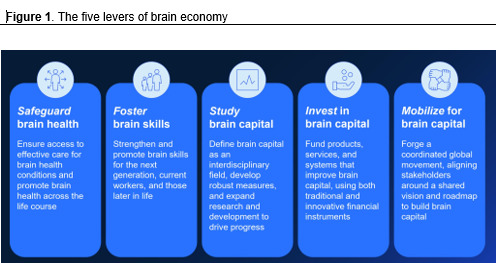
Recognizing these challenges, the World Economic Forum, in partnership with the McKinsey Health Institute, established the Brain Economy Action Forum to convene stakeholders globally, elevate the global dialogue around Brain Capital, and advance policies and investments that support brain health, brain skills, and Brain Capital development. Their work reflects a broader shift in thinking, from viewing brain-related conditions primarily as economic burdens to recognizing brain health as an opportunity for societal growth and prosperity.11 As part of this emerging framework, the Forum proposed five key levers of the Brain Economy as a foundation for sustainable growth and societal well-being and emphasized the importance of strategic action as solutions are developed (Figure 1). These levers are intended for use as an emerging roadmap for action for healthcare systems. Implementation will require adaptation across sectors and settings, sustained investment, and appropriate incentives. This perspective reframes investment in brain health as an investment in human potential.
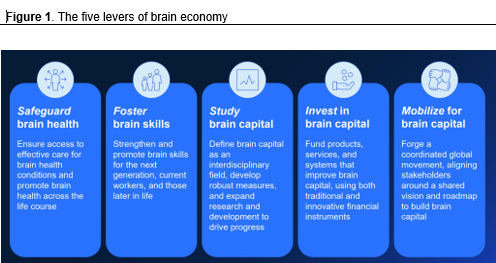
First, safeguarding brain health emphasizes the prevention and treatment of neurological, mental, and cognitive conditions throughout the lifespan. Second, fostering brain skills focuses on developing the cognitive, emotional, and social capabilities necessary for learning, adaptation, and innovation. Third, studying Brain Capital highlights the importance of establishing robust measurement systems and expanding research to better understand the factors that influence brain health and human potential. Fourth, investing in Brain Capital recognizes the need for sustained financial support for programs, services, technologies, and policies that enhance cognitive and emotional well-being. Finally, mobilizing for Brain Capital calls for coordinated action among healthcare systems, educational institutions, employers, policymakers, researchers, and community organizations.11 These levers illustrate that advancing the Brain Economy requires more than healthcare reform alone. A comprehensive societal approach to developing, measuring, protecting, and investing in the cognitive and emotional resources that drive individual and societal prosperity is now an imperative.
Despite this shift, contemporary health care systems remain largely organized around a reactive model of care. Clinical practice is typically structured to identify and treat diseases after symptoms emerge, often within narrowly defined specialty silos. While this approach has generated important advances in acute and chronic disease management, it is poorly suited to preserving and optimizing brain health across the lifespan. The dynamic nature of brain function requires a more proactive and integrated approach. This Perspective examines the relationship among brain health, Brain Capital, and the Brain Economy and considers the implications of these emerging concepts for the evolving role of healthcare systems. Realizing the potential of the Brain Economy requires a fundamental paradigm shift in health care systems from a disease-centered reactive model to a model that focuses on proactive approaches to brain health and Brain Capital across the lifespan,12 with a greater emphasis on prevention, measurement, and cross-sector collaboration.
The Necessity of a New Clinical Paradigm
From Reactive Treatment to Proactive Brain Health Stewardship
The traditional medical model focuses primarily on diagnosing and treating pathology once clinically significant symptoms have emerged. In the context of brain health, this often means intervening only after the onset of major depression, cognitive impairment, substance use disorders, dementia, or other neurological and psychiatric conditions. While such interventions remain essential, they may occur after substantial declines in brain function have already occurred.
A Brain Economy-oriented clinical model requires a fundamental shift from reactive treatment to proactive stewardship of brain health. Similar to the evolution of cardiovascular medicine from treating heart attacks to managing cardiovascular risk factors throughout life, brain health care must emphasize preservation, optimization, and prevention long before disease develops.
This approach begins with a lifespan perspective. Brain health is shaped by experiences and exposures throughout development, beginning before birth and continuing into older adulthood.13 Early childhood nutrition, education, social connection, stress exposure, sleep quality, and environmental conditions all contribute to the accumulation or depletion of Brain Capital.12–15 Likewise, midlife interventions that promote physical activity, cardiovascular health, stress management, and cognitive engagement may help preserve cognitive function and reduce future disease risk.16 Clinical systems must therefore expand their focus beyond disease treatment to include the long-term cultivation of brain resilience and reserve.
Incorporating non-pharmacological interventions as primary tools is important for enhancing neuroplasticity, reducing dementia risk, and improving midlife cognitive performance, mood stability, and stress resilience. Evidence from randomized trials and systematic reviews increasingly supports the role of multidomain lifestyle interventions in promoting brain health. Physical activity, healthy nutrition, sleep optimization, cognitive stimulation, social engagement, and management of cardiovascular risk factors have each demonstrated benefits for cognitive function, emotional well-being, and dementia prevention.17,18 These interventions should not be viewed as ancillary recommendations but rather as core components of brain health care. The future of clinical practice will likely involve routine integration of brain health assessments alongside traditional physiological measures, allowing clinicians to identify emerging risks before they manifest as clinically significant disease. Indeed, routine mental status assessment, which has been conceptualized by some as a “fifth vital sign,” is essential to proactive and preventative care.19
Emerging technologies may further support this transition. Digital biomarkers, wearable devices, and remote monitoring tools offer opportunities to measure cognitive, emotional, and behavioral functioning in real-world settings. Rather than relying solely on episodic clinic visits, clinicians may increasingly utilize continuous streams of information regarding sleep, activity, stress, mood, and cognitive performance.20,21 Advances in artificial intelligence and machine learning can help synthesize these large and complex datasets, enabling earlier identification of brain health risks, more precise prediction of outcomes, and individualized intervention strategies.22,23 At the same time, virtual care and telehealth platforms can expand access to cognitive, behavioral, and neurological health services, particularly for underserved and geographically dispersed populations. Together, these technological innovations support the development of personalized brain health programs informed by real-time data, allowing care to be tailored to an individual’s unique biological, behavioral, and environmental profile.24,25 Such approaches have the potential to transform brain health. These technologies allow clinicians to move from episodic, reactive care to continuous, personalized brain-care ecosystems.26
Adoption of Holistic and Interconnected Models of Care
A second limitation of the traditional medical model is its tendency to separate health into distinct organ systems. Brain health is deeply interconnected with biological, psychological, and social processes throughout the body. Preserving Brain Capital therefore requires clinical models that acknowledge and address these complex relationships.
The gut-brain axis provides one example of this interconnectedness. Research increasingly demonstrates that the gut microbiome influences cognition, mood, stress regulation, and neurodevelopment through immune signaling, microbial metabolites, vagal pathways, and inflammatory mechanisms.27,28 Disruptions resulting from poor diet, infection, antibiotic exposure, or chronic stress may have lasting implications for brain health across the lifespan. These findings suggest that nutrition, inflammation management, and microbiome-informed care should be considered important components in promoting brain health.
Similarly, cardiovascular, kidney, and metabolic health are closely linked to brain outcomes. Conditions such as hypertension, diabetes, obesity, heart failure, and chronic kidney disease contribute to cognitive decline through vascular, inflammatory, and metabolic pathways. Increasingly, evidence suggests that interventions traditionally viewed as cardiovascular risk-reduction strategies may also serve as brain health-preservation strategies.29–31 This reinforces the notion that protecting the brain requires coordinated attention to whole-person health.
Sex and gender also influence brain health trajectories in important ways. Women experience unique biological transitions across puberty, pregnancy, perimenopause, and menopause that affect neurological and psychological health. They also face distinct social determinants, caregiving responsibilities, and health care disparities that shape brain health outcomes.32 Evidence highlights that women have higher lifetime prevalence of mood and anxiety disorders, experience different symptom presentations, and are often underdiagnosed or misdiagnosed for neurological conditions such as migraine, dementia, and autoimmune-related cognitive dysfunction.33,34 A Brain Economy–aligned clinical model must therefore incorporate sex-specific risk assessment, research-informed clinical guidelines, and tailored prevention and treatment strategies to ensure accurate diagnosis, effective intervention, and equitable brain health outcomes across the lifespan.
Together, these examples illustrate the need for integrated clinical models that move beyond traditional specialty boundaries. A Brain Economy-focused health system must recognize that preserving Brain Capital requires coordinated attention to physical, emotional, social, and environmental determinants of health.
Future Directions for a Brain Economy-Oriented Health System
Realizing the full potential of the Brain Economy will require changes that extend beyond clinical practice alone. Policymakers, educators, employers, community organizations, and health systems all play critical roles in shaping the environments that influence brain health. Population-level fiscal and regulatory policies that address established determinants of brain health- including tobacco and alcohol use, nutrition, education, and environmental exposures- are important components of the broader discussion. A Brain Economy framework recognizes that brain health is both a healthcare issue and a societal asset, requiring coordinated investment across multiple sectors. However, the present Perspective focuses specifically on the role of healthcare systems and their partners in translating effective Brain Economy principles into practice.
Workplace environments represent an important and often underutilized setting for promoting brain health. Policies that reduce chronic stress, support flexibility, encourage lifelong learning, and foster social connection may enhance both employee well-being and organizational performance. Examples of emerging workplace strategies include flexible work arrangements that support recovery and work-life integration,35,36 designated quiet or sensory-friendly spaces for employees experiencing migraines or cognitive overload,37 or organization-wide sleep health initiatives.38 As evidence linking brain health to productivity continues to grow, employers are increasingly positioned as important partners in Brain Capital development. Many of the leading determinants of brain health, including sleep quality, stress exposure, workload, social connection, and cognitive demands, are shaped by workplace design and organizational culture.
Health care financing models may also represent an important lever. Current reimbursement structures often reward treatment of disease rather than prevention and optimization. Incentive models that support brain health screening, lifestyle interventions, behavioral health integration, and long-term prevention may help align clinical practice with Brain Economy objectives.
Future models of care may increasingly incorporate individualized neuro-interventions informed by biological, behavioral, and digital biomarkers. Genetic information, blood-based biomarkers, neuroimaging findings, and real-time behavioral data could be integrated to tailor prevention and treatment strategies to everyone’s unique profile. These advances may also support the development of neuro-wellness clinics dedicated to optimization and prevention, bringing together expertise from neurology, psychiatry, sleep medicine, cardiology, nutrition, metabolism, women’s health, and behavioral coaching to address the multifactorial determinants of brain health.
These approaches illustrate potential pathways for translating Brain Economy principles into practice. However, they should not be interpreted as prescriptive recommendations for universal adoption across healthcare systems. Evidence supports many of these individual strategies, but important questions remain regarding cost-effectiveness, scalability, comparative effectiveness, and population-level impact of Brain Economy-aligned interventions. This presents a critical research priority: determining which approaches most meaningfully improve brain health and Brain Capital.
One promising framework for advancing these goals is the development of a Brain Economy Learning Health System. Building upon the broader learning health system model, such an approach would continuously integrate clinical care, research, data analytics, and quality improvement.39,40 Every patient encounter would contribute to the generation of new knowledge regarding brain health, while emerging evidence would be rapidly translated into practice. The learning ecosystem need not end at the boundaries of the health system. Community-engaged anchor institutions and academic health systems can partner with universities, local governments, employers, and community organizations to connect clinical and population health insights with strategies to help shape the environments in which people live, work, learn, and age. Such partnerships create opportunities to extend Brain Economy principles into community development, recognizing that social environments are critical determinants of brain health and Brain Capital.41,42 Through continuous learning, adaptation, and collaboration, health systems could accelerate progress toward preserving and enhancing Brain Capital at both individual and population levels.
Conclusion
The emergence of the Brain Economy represents a significant shift in how societies conceptualize health, productivity, and human potential. Rather than viewing neurological and mental health conditions solely through the lens of disease burden, the Brain Economy highlights the value of investing in the cognitive, emotional, and social capacities that drive individual and societal success.
To support this transition, health care systems must evolve from reactive models focused primarily on disease treatment toward proactive stewardship of brain health across the lifespan. This shift requires greater emphasis on prevention, integration across specialties, personalized interventions, and technologies that enable continuous monitoring and support. It also requires collaboration among clinicians, researchers, employers, educators, policymakers, and communities to create environments that foster the development of Brain Capital.
As the field continues to mature, structured consensus-building efforts may help define the core metrics, implementation strategies, and governance structures necessary to operationalize Brain Economy-aligned health systems. Ultimately, advancing brain health is not simply a clinical objective; it is a societal imperative. In an era where cognition increasingly serves as the currency of economic success, preserving and enhancing Brain Capital may become one of the most important investments societies can make.